
01 · Find the relationship failure
Supply-chain failures often begin as relationship failures.
A farmer failing to supply a hotel consistently may look like a logistics problem. Underneath it may be unclear demand, misunderstood quality requirements, uncertain purchasing commitments, fragmented transport, limited knowledge of other growers, or trust damaged by past experience.
This project therefore starts with relationship discovery as well as data collection: who already works together, who calls whom when demand changes, who is trusted to coordinate, where collaboration has failed, and what would make a commitment credible.
Design principle: move at the speed of trust.
Technology should make relationships more legible and commitments more reliable; it should not outrun the institutions and people expected to use it.
02 · Connect trusted nodes
A mycelial food network, not one centralised marketplace.
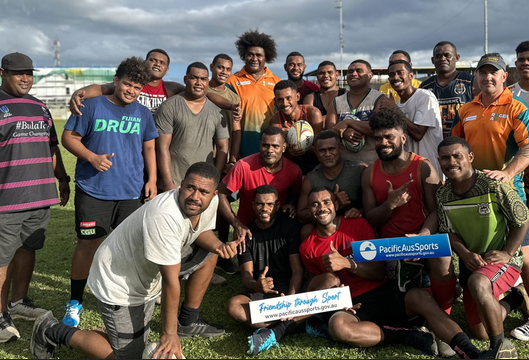
A rugby club does not need to become a giant food hub. Several clubs can operate as connected local nodes: farmer → club or community node → regional aggregation → buyer. Each node retains local relationships while the intelligence layer creates visibility across the network.
Identify farmers and trusted coordinators
Aggregate produce without centralising control
Coordinate quality, pickup and transport
Create roles for youth and community institutions
Carry local knowledge into regional decisions
A commitment, made visible
150 kg
Buyer forecast
90 kg
Confirmed capacity
60 kg
Gap to organise
The system does not pretend supply and demand match. It exposes the gap early enough for growers, coordinators and transporters to organise around it.
The research begins in the Korovou–Tailevu–Natovi corridor and can extend to other parts of Fiji only where relationships, governance and operating evidence support it.
03 · Measure trust and change
Capture the system—not only the suppliers.
The research records actors, relationships, interaction frequency, broken commitments, trusted coordinators and what could strengthen collaboration. It pairs baseline and follow-up trust measures with operational results and a relational story.
Trust baseline
Confidence in commitments, reliability and willingness to plan together.
Relationship map
Who sells, buys, coordinates or transports for whom—and how frequently.
Market gap
Forecast demand, confirmed capacity and the shortfall the network must organise around.
Change story
Quantitative change paired with a documented account of how coordination improved or failed.
The people and the journey
Fiji-led, combining agrifood research and public-interest technology.
Pacific Food Intelligence emerged through the inaugural Australia–Pacific Youth Food Lab, an initiative of the World Food Forum Australia Youth Chapter. The work brings together agrifood systems research, stakeholder discovery, data governance and digital systems design.
Professor Steven J.R. Underhill—Director of the Australian Centre for Pacific Islands Research and Professor of Horticulture at the University of the Sunshine Coast—provides programme advice. The work is moving from relationship discovery in the Korovou–Tailevu–Natovi corridor toward co-design and a bounded pilot, with expansion determined by evidence and community consent.
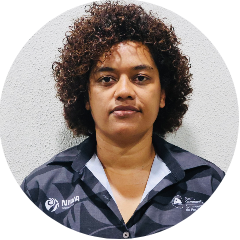
Koto Qalo
Open data and systems architecture
Leads the relationship-intelligence model, data governance, institutional coordination and technical architecture.

Natalia Rebollo Sampedro
Agribusiness and agrifood innovation
Leads agrifood research, stakeholder discovery, market analysis and partner engagement.
Live research pulse
Research in progress, shared without exposing participants.
This anonymous view updates from the research database. It publishes aggregate participation and recurring coded themes—not names, organisations, contact details, locations, written answers or individual submission times. Every displayed category represents at least three consented submissions.
12
Consented research submissions
12
submitted in the past 30 days
9
open to research follow-up
Disclosure rule: minimum cell size n=3. Counts may overlap because contributors can select several participation pathways. Figures describe this research cohort and are not representative estimates of Fiji's population or food system.